
The TomorrowZone Catalyst Podcast
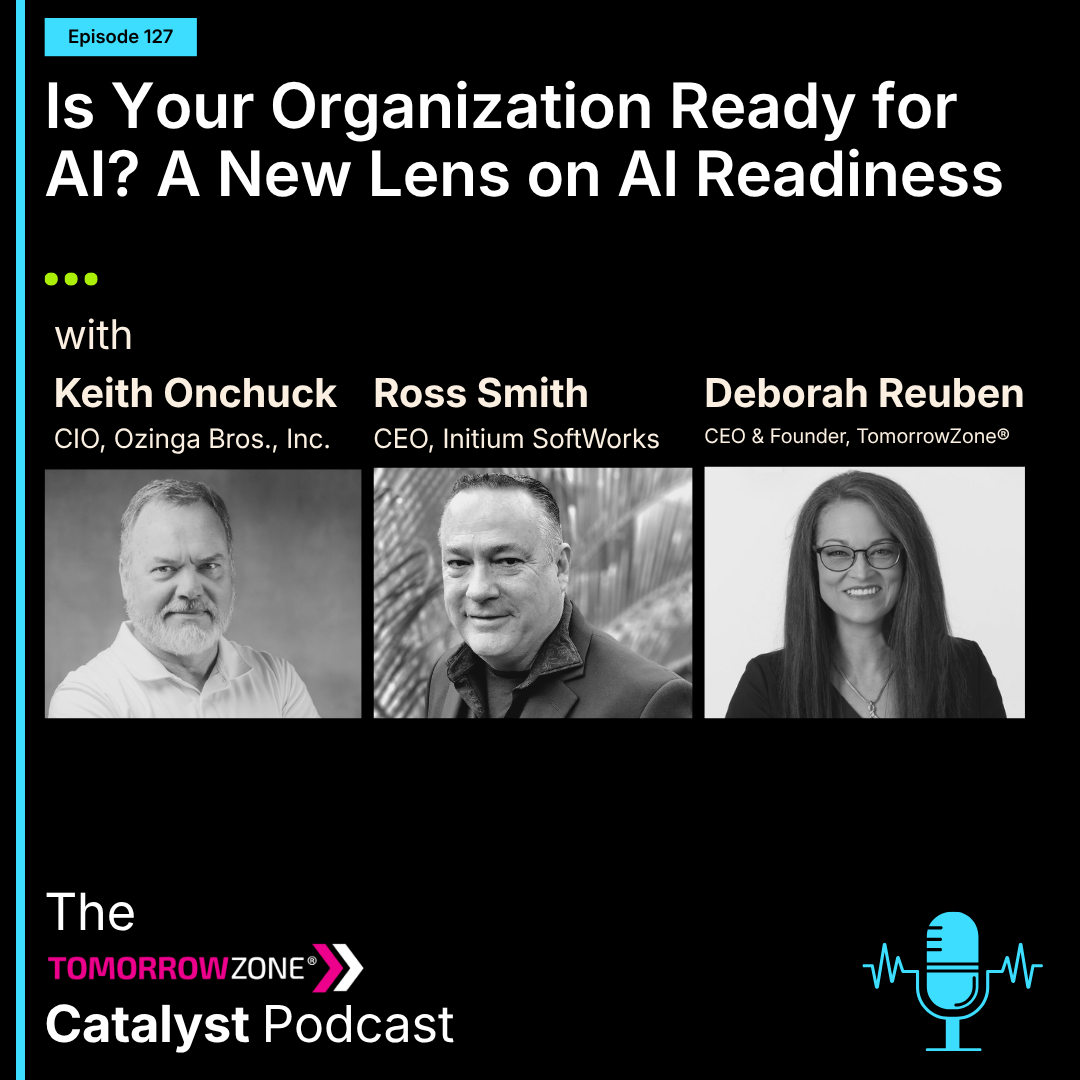
127: Is Your Organization Ready for AI? A New Lens on AI Readiness
About this Episode
Deborah Reuben, Ross Smith, and Keith Onchuck reveal why AI readiness depends on clarity, data, governance, and people. What does it really take to prepare an organization for AI?
This conversation explores the leadership and business foundations that help organizations move from AI urgency toward meaningful business value.
In this episode, you’ll hear perspectives on:
- What AI readiness really requires beyond the technology
- Why strategic clarity, data, and business context shape AI outcomes
- How governance can create guardrails for confident experimentation
- Why transformation readiness must keep evolving as AI and business conditions change
Meet the guests:
In this special edition of The TomorrowZone Catalyst Podcast, Deborah Reuben, CLFP, CEO and Founder of TomorrowZone®, joins Ross Smith, CEO of Initium SoftWorks, and Keith Onchuck, CIO of Ozinga Bros., Inc. This episode is drawn from a live conversation hosted in partnership with Initium SoftWorks.
Deborah Reuben, CLFP, is CEO and Founder of TomorrowZone®, a clarity-first transformation advisory serving C-suite and senior operational leaders in equipment finance, leasing, and beyond. She works with leaders at critical inflection points, helping them clarify the real problem before technology decisions are made, significant resources are committed, or the wrong direction gains momentum. Grounded in systems thinking and foresight, Deborah helps leaders strengthen transformation readiness and create clarity about what comes next. She is the author of Enter the TomorrowZone: How to Inspire Breakthrough Innovation and Shape Your Future and has authored editions 6 through 10 of the Certified Leasing and Finance Professionals’ Handbook. Deborah is also the host of The TomorrowZone Catalyst Podcast, where she brings forward conversations that challenge leaders to think differently about transformation, innovation, and the future.
Ross Smith is CEO of Initium SoftWorks LLC, where he leads the company’s strategic vision and delivery of enterprise content management solutions. Drawing on experience in professional services, consulting, and manufacturing process improvement, Ross focuses on helping organizations streamline digital transformation journeys and connect complex processes with effective content management strategies. His work emphasizes operational excellence, customer experience, collaboration, and practical solutions aligned with business objectives. In this episode, Ross brings that perspective to AI readiness, exploring what organizations often underestimate as they move from AI experimentation toward broader adoption and why leaders need to consider the organizational and operational foundation surrounding the technology.
Keith Onchuck is Chief Information Officer at Ozinga Bros., Inc., bringing more than two decades of experience driving digital transformation, operational efficiency, and strategic innovation across the construction and logistics industries. At Ozinga, he has led technology initiatives through a period of significant growth, including AI-powered data lakes, mobile customer portals, and integrated ERP and CRM systems. His leadership has delivered multimillion-dollar cost savings, streamlined operations, and stronger customer engagement. Keith also serves on multiple industry advisory boards, contributes to the National Ready Mixed Concrete Association’s Digital Transformation Task Force, and is a three-time CIO of the Year nominee by the Chicago Chapter of the Society for Information Management. In this episode, he brings a practitioner’s perspective to building a strong foundation for AI readiness.
For leaders navigating AI strategy and organizational transformation, this conversation offers practical perspective on readiness before significant resources are committed. AI readiness isn’t a one-time checkpoint. Continuous Readiness, a core principle of TomorrowZone®, means continually reassessing what the organization needs as technology, business priorities, and conditions change.
Clarity before technology.
Connect with Us:
Deborah Reuben (00:00)
Welcome to the TomorrowZone Catalyst Podcast. I’m your host, Deborah Reuben Many leaders that I talked to today are feeling pressure to do something about AI. You might be feeling it too. And I just want to recognize that pressure is real. But urgency is not readiness. Today’s episode is a replay of a live session that we hosted in partnership with Initium SoftWorks. And it features one of their clients, Keith Onchek, CIO at Ozinga.
Together we explored what true AI readiness means from multiple angles. Quick note for our audio only listeners: there are a few visuals in this session. You can find the full recording on YouTube at tomorrowzone.io. Now let’s get into it.
Jennica Burgh (00:46)
Well, welcome everyone. Thank you so much for joining us for Is Your Organization Ready for AI, the foundation most companies are missing, presented jointly by TomorrowZone and Initium SoftWorks. I’m Jennica Burgh Director of Operations for TomorrowZone, and we’re so glad you’re here. I’m sure you’ve been informed as you’re joining, but we are recording this webinar.
Today’s format will be three rapid-fire presentations followed by a discussion. And if you have questions at any time, please put them in the chat. We’ll bring them into the discussion in the second half of our time together. And please feel free to use the chat to interact throughout. To get started, I have the honor of introducing Deborah Reuben CLFP. Deb is the CEO and founder of TomorrowZone, a Clarity First Transformation Advisory.
She works with senior leaders at the inflection points that determine transformation outcomes before the technology decision, before significant resources are committed, before the wrong direction gets momentum. She’s the author of Enter the TomorrowZone: How to Inspire Breakthrough Innovation and Shape Your Future. And make sure you stick around until the end today because she’s giving away two signed copies of her book. Deb, over to you.
Deborah Reuben (01:57)
Thanks, Jennica. Hi, everyone. I’m so glad that you are joining us today. We’re gonna talk about a little bit of a new lens on AI readiness and explore from a variety of perspectives what that means. Before we go too far, though, one of the challenges that I often see is we’re always saying the same thing, but if we saw the thought bubble above everybody’s head, we might see something different in each one. And so before we go too far,
There are a couple of words that I want to define. When we’re talking about AI, we’re talking about technology performing tasks that are typically requiring human judgment, generating content, analyzing data, or recommending, things like that. So we’re not gonna spend a lot of time debating what AI is. Cause what we wanna focus in on is what does readiness mean when it comes to AI? And readiness is defined as being prepared, willing.
Able to act. And so the first thing that I want to do is take a little bit of a pulse check of our virtual room. You should see a chat button on the bottom of your screen. And I’d love you to just hit the chat button and share in the chat, in one or two words, what does AI readiness mean for you right now? So just give give a thought to that. What does AI readiness mean to you?
Can be one or two words. So I welcome you to join in the chat. What does AI readiness mean to you right now? Informed and enabled, being prepared, methodology for use, secure and defined work streams. Ooh, courage to try new things. Good stuff coming out of here. Operational readiness.
So we can see there’s a lot of different perspectives coming into play as we are thinking about AI readiness and this prepared to use AI with the work environment, ethical and proper usage. So there’s a lot of I haven’t seen anybody say which model should I select? Awesome.
So so that’s really great. and so applicability, that’s a really good word too. Applicability. So, you know, the challenge that we’re facing, a lot of leaders today are under pressure, and that pressure is real, pressure to do something with AI. We’re surrounded by hype. We’re also surrounded by amazing opportunity. You may be in a situation where your board is asking you to do something with AI or vendors are calling with really attempting devices and applications of AI that might fit your business. Competitors are already moving on it. Some interesting research that I ran into, McKinsey has been doing, they have found that 48% difference between organizations that are actually capturing value with AI versus not capturing value. And interestingly, 25% of that is made up of personal rather than team productivity. There’s a very big difference between individual productivity and value with AI and team value and productivity with AI. And so we’re gonna get into a little bit more of what it means, but you know, I just want to acknowledge that I understand the urgency is real. And the thing that I wanna get really clear is that urgency is not the same as readiness.
So let’s talk about what readiness means. Readiness is both continuous and it’s multidimensional. As we saw in the responses in the chat, there are a lot of different ways that we need to view our readiness for getting value from AI. It’s both organizational and tech ops. And so on the organizational side, readiness includes the dimensions of people, process, policies.
Understanding the forces of change in and around your business as well as leadership alignment and not just leadership alignment one time, but continuous. And then on the technology and ops side, there’s data, integration, there’s content management, the governance structures, the infrastructure. So all sorts of things that we need to be thinking about on multiple dimensions. And the thing is readiness is not just something that you look at one time. And a lot of organizations are looking at it like a one-time checklist. We often have an assessment that we’re doing or taking a snapshot of our readiness before we do something with AI. We all recognize that we have a dynamic reality. Conditions are always changing. But I think the thing a lot of folks are missing, the missing link is continuous recalculation of our readiness. Because our readiness conditions are always shifting and the constantly changing conditions in our reality always trigger the need to take another look at our readiness calculation. And then that updates our readiness conditions. And it’s like a feedback loop. I think of it one analogy that I use to think about this is kind of like assessing credit exposure. You know, many of the people in our audience today may be from the finance industry. So you would recognize the importance of managing and monitoring.
The credit exposure that you have with a client, well, you never look at it just once. It’s always a snapshot in a point in time. And as conditions change, as deals are paid down, as new deals are brought on for that relationship, that exposure calculation is going to change. Transformational readiness is very similar to that. So, you know, think about it the way that you would think about monitoring credit exposure. It’s a continuous calculation. And so
That is one of the big things that that we talk about at TomorrowZone is getting clarity before technology, clarity on all of those dimensions of readiness before the investment, before the big move, before you get going really fast in the wrong direction. And that message is the idea at the heart of my new book, Enter the TomorrowZone.
So if you stick around until the end, I will be asking a question. And the first two people to answer that question in the chat will get a signed copy of my book, which is now available in all formats. We’re really excited to finally be able to announce that. and so with that, we’re gonna move on because I think that it’s really important to dive into each of these lenses. And I’m going to first go to Ross Smith.
And I’m gonna ask you to hold your questions and comments until the end, but we do welcome you to engage within the chat. If you want to ask a question, if you want to add a comment to what to support what one of the speakers is saying, please feel free to engage in the chat. And then the second half of this session, we will be having a discussion where we will invite interaction.
And so I want to introduce Ross briefly. He’s the founder of Initium SoftWorks, our technology partner, specializing in integration, data, and content management infrastructure that really makes AI work. And I think that he has a really important point of view because it’s from the intersection of strategy and execution. And he’s gonna share with us what AI readiness looks like when you get under the surface. So over to you, Ross. Take it away.
Keith Onchuck (09:15)
Thank you, Deb. Appreciate being here and a part of this and the partnership that we have. Fortunately, I’m not here alone. I have several ISW team members with me because we can’t do it without a team. So excited that they’re here. So throw the curveballs at us and we’ll we’ll address them as they come up. And you talked about pressure, Dub. organizations are feeling pressure right now from an AI perspective, but we’ve experienced it, you know.
Working with clients over the past 30 years, you know, in all levels of projects and tech solutions that they’re adopting. We’ve been doing a long time and the pressure’s real. You know, as a natural progression to the process automation consulting that we’ve been doing for years and integrate integration platforms we’ve been developing for years, we evolved into AI advisory consulting, which, you know, it’s a natural evolution into that.
In that evolution, we discovered really something that’s really obvious. Organizations have a clarity problem. They put tech and now AI platforms before they’re aligned internally. What does that mean? What problems they’re trying to solve? What outcomes and results they’re chasing? Who owns and is accountable to what makes things happen and what success actually looks like. When we talk about being ready to drive into AI.
It’s more than leveraging it. Everyone on this meeting is already doing that. We’re talking about whether your organization is prepared to create real results. We’re basically seeing two camps when it comes to AI adoption. They are either very careless and haphazard and just diving into it, you know, without too much clarity and understanding, or they’re not taking any action because they’re waiting for perfection, you know, before they move forward.
And then there’s the other camp where people are just so scared because I’m not sure what that movie was, but you know, the cyberdyne systems movie where you know AI is just going to take over the world. So I’m just not going to do anything. So those are the camps that we’re experiencing. so when we ventured down the AI readiness path, and what we really tell our clients, readiness is about asking ourselves if we understand enough to take the next responsible step.
We do that by getting clarity around is the problem worth solving? Clearly identifying the process that will change things, who will be impacted, what information is required for success? Where is the human still needed in the loop? Which, if the human is not part of it, you know, you’re trusting too much, really, is what it comes down to. As we all know, data is the backbone to leveraging AI. We’ve all been creating.
Content chaos for the past 20 years. We all have data from emails, documents, policies, images, workflow processes, historical information, team chats, you know, you know, team recordings, team transcripts, and other things that are just all over our networks. And we’ve been accumuling accumulating that forever, thinking that we’re gonna organize it one day. Fortunately, AI can.
And the LLMs out there and the models and the platforms can enable us to leverage that data now. I bet everyone on this call or organizations are leveraging AI for the basics. We prompt the question, we get an answer, believe what it says, and then we get excited. We just save 10 hours doing research that AI just get did us, you know, gave to us in five minutes. That’s not enough though.
If that was enough, you wouldn’t be on this webinar. You wouldn’t be looking for you know other platforms. You wouldn’t be traveling to, you know, other locations to go to events to learn more about what it is that you know AI can do for you. So the next basic steps and utilizing it is to think about how to leverage AI to improve processes. You want to intelligently trigger.
Notifications, sync systems through integration, retrieve or archive information based on AI logic, you know, document decisions or recommend outcomes automatically. And bottom line is that if your organization doesn’t do more with it, then all A AI is doing for you is collecting data, you know, watching what you’re doing, and you’re not leveraging it to, you know, operationalize and improve efficiencies in your organization.
And that’s why AI readiness is important. And now we’re going to get into the word we don’t like to talk about and what is really important when it comes to AI readiness. And that is if you have the idea of what the word is, put it in chat. But I’ll let you know it’s governance. Governance is usually seen as you know, bureaucracy, you know, restraints, you know, and is really a vague term for.
You know, getting control over how you manage, you know, your your AI and your adoption of it. You know, who can do what? What information can be used, who approves it, how results are reviewed, and who owns the results. Governance always evolves because every day the tools change, the models are going to change, and that’s just the way it is going forward. So you should not define government governance based on the platform.
Because if you do your governance right, it outlasts the technology changes that come over the years. A good governance will survive tech cycles. Let’s get into what happens when technology comes first. That’s on the slide also. If you put technology first, you’re just buying a tool, you run a pilot, everybody gets excited, reality, and then reality arrives. We discover data isn’t clean, systems don’t connect.
Nobody’s documented the exceptions. Ownership isn’t clear. Success was never defined. Security of business got invited too late. So the business and IT are not connected correctly and the project stalls, or you know, there’s scope creep or there’s overruns. There’s a lot going on when tech is put first. And the fact is, technology using usually isn’t a core that the project.
Challenges, clarity around the foundation and defined results were never established. Changing the mindset approach changes the outcome. And that’s why TomorrowZone and ISW works. The partnership is a natural fit because what we do and believe at the core complements each other. We’ve been helping organizations modernize with technology and automation processes for decades. We’ve been doing it for a long time.
What we have discovered from executing thousands of projects is that often organizations we work with are internally disconnected, which impacts user adoption, creates false starts, the move in different technology directions routinely happens all the time, or duplicate tech solutions in multiple parts of the organizations are being implemented and purchased, even though it’s the same technology accomplishing the same goals, but it’s you know throughout the organization being overrun on cost and things like that. That’s when the concept of clarity before technology makes sense. Common sense, but not common practice. It’s attempted, it’s just not easily executed. That’s where tomorrow zone helps answer questions like where are we going? What’s changing? What future are we trying to create? Are we aligned? ISW helps answer how do we oper operationalize it?
What systems connect, what data moves, what govern governance is needed, and what gets automated. Our partnership sees it like this. TomorrowZone helps define the destination. ISW helps build a highway to that destination. And with that, I’m handing it back to you because I believe we’re getting into Keith’s.
Deborah Reuben (17:18)
Awesome. Thank you so much, Ross. I I took a wa away a few things from that and I was sharing a little bit on my of my thoughts in the chat. But one of the things I love is reframing our thinking about governance, that it’s not about bureaucracy, but it’s about enabling you and your team to move forward confidently to shape the future despite the continuously changing technology environment. And I think that’s really, really vital as a foundation.
For AI readiness. One of the perspectives that I really wanted to share with you on this important topic is from a practitioner. And so I want to introduce to you Keith Onchuck. Keith is the CIO at Ozinga Brothers, a bulk construction materials company that deliberately and proactively built an AI foundation for their company before the pressure to move fast made it hard to think clearly about it. And I really love how Keith thinks. He is a business first technologist and he’s gonna show you what this looks like in practice. And then after Keith’s presentation, we’re gonna get into a a conversation about AI readiness and what it means for all of us. So Keith, over to you.
Keith Onchuck (18:32)
Sounds good. Thank you, Deborah. Hello, everybody. so being a technology leader in a company like this, we are inundated with new technology every single day. If you think about it, whether it’s AI, whether it’s dot-com, whether it’s mobile apps, everybody’s got this promise of technology. The thing is, what we’re trying to do is solve business issues. We’re trying to figure out what makes the business better, what makes our people more effective, what makes the business more profitable in the long run. So we kind of have to.
Always have this business first approach that says, how does technology impact the business? Not the other way around. We need to make technology that brings value. So if we start talking about AI, in construction, we always talk about a blueprint and a foundation. Well, the blueprint is your clarity before the technology that you create. So I want to share with you a little bit of what we did and how we implemented.
An AI solution that is still ever evolving. It’s never done. It’s going to continue to go. So the first thing we kind of did in the blueprint is we built a roadmap. You know, what do we want out of an AI tool? Do we want personal productivity? Do we want a gen tech models? We actually want a little bit of both. So we kind of built our framework for what do we want to do. Then we put implemented an AI policy. These are your rules for the road, you know, your governance model.
What do you need to do to be successful? how does a user manage master data? How does security roles get implemented? And how do those security roles adhere to what it is that you’re trying to do from a compliance standpoint? And then who’s using the system? Who are the users? Every technology solution should always be approached from the user perspective first. How do you simplify? How do you simplify their interaction with technology? You have to.
Make it easy for them to use it, because if you do not, they are not going to embrace it. The other important part about the users in the blueprinting is they know the data, they know the business, they know the stories that they need, answers that AI can provide. So you have to listen very clearly to the users to determine what needs to be put into this roadmap, what needs to be put into this blueprint. You can go to the next slide. So when we start talking about
Okay, so when we start talking about the next phase of blueprinting, you also have to do an education. Not everybody knows how to use AI. How do you prompt it? You know, what are the ways you ask questions? And then we have to talk about context. So, how do you build that translation between your data and the human speak so that when a person is asking questions of the data, it makes sense. So in our example here,
We are a ready mix concrete producer primarily, and we always say our production is in terms of volume. What is my volume today? Well, volume in my world means my production. So we already have that mapped in an LLM that says, when I ask these phrases, this is what it means. Or when I ask, what is a round trip travel time or dead time? It knows these definitions. That context is really important when you’re building these solutions.
Then success. What does success look like? And this is one people have to be careful of because if you put in an AI solution, they’re going to fail. But you know what you do is you learn from the failure and you fall forward and you go into the next one and you take what you learned from the first one and you continue to evolve. So you always have to have a definition for what is success for this model. And if you don’t achieve it, well, reiterate: was it a problem with the model? Was it a problem with the data?
Was it a problem with the context? We’ve all looked at information technologies providing reports. And these reports always provided a story. My thought is AI takes that story and brings you meaning. So then we talk about data. You need to inventory your systems. What are the systems that you have and how do you want to have them interact with an AI engine? So go through and understand what systems are out there. Once you understand what systems.
What type of integration do we need? How frequently do I need that information brought in? Is it real time or not? And then be able to build your integrations accordingly. What tools do you need to solve your problem? So you want to pick a technology that suits your own skill set and suits your own problem. You have to be careful when you’re looking at technology that’s going to work and integrate in the environment you have. And ultimately, you must keep the human in the loop.
It’s really important that the human is in the loop. It’s a culture shift. We’re looking at trying to make our folks more productive with the information that they have. We’re not trying to replace them. So when when I look at a foundation, I always think of somebody’s building a house. So the house is built upon a bedrock, and then there’s footing, walls, floor, and then you have the finished product. Well, in our case, the bedrock is what anchors everything that we do.
So this is where your context comes into play. This is where you need to be able to have your questions about your business phrased in such a way because that’s also the anchor and that’s the end point, but you need to start with that being in there. When you look at the footing, that’s kind of the inventory of your systems. What systems are you bringing in? Do you have an ERP system, a time in attendance, an HR?
Safety, what systems do you have? You start building that data in a series of data lakes that are able to have that information presented, which you can then ultimately put a LLM in front of it that has the context that knows how to interact with that data. Then once we get into that, we start building the walls. And in the walls are kind of again, your integration coming in, building all that information to pull together the story.
Of all of that data that you have that allows you to bring meaning to it. In our case, we have 37 disparate data systems that are feeding into this framework that we have. Some are coming in real time, some are not. They might be SaaS solutions, they might be on-premise solutions, they might even be IoT devices that we’re bringing in. Then when we start to look at the floor again, now this is where we’re at our language model.
This is kind of reiterative, but context is so critical in all of this. We need to be able to communicate and interact with the system in a way that our users know how to do it. Which brings us to our finished product of our home, where we now can look at this tool as a coach. It helps us make decisions better. This coach can compute things faster than a human mind could.
So if I have a thousand trucks on the road every day and they’re all adhering to a schedule and 10% of them are off by three minutes, I might not know how that impacts my finance at the end of the day. But the system would, and it would be able to prompt me maybe to take a change in the way I’m interacting with the business today. So in in the home sweet home area, this is where it is that rinse and repeat. It’s redundant, it’s reiterative. We constantly build upon the solution.
Sometimes we take away parts that we put up and we add additions onto the home as we need it. So the the blueprint is your shining North Star. It’s where you want to go. This is what you start with from a template. And then once you have that template built, you have your strong business business actuum in there. You’re now able to move in and live into this home and be able to get the value out of it that you want. So that was kind of the journey that we took.
In order to get ourselves up and running in an AI environment. And then again, this concept of these large language models, we are constantly adding them. As people ask questions and they get an answer, the business people need to interact with the IT people to go through: okay, what was the ask? What was the answer? Was it correct? The business people can tell you, and then the IT people can perfect it. And eventually, you’ll get that agentic agent where you have so much faith in it that you believe in it that you’re now maybe able to release it to even take initiative on its own and truly augment you to move you into doing something a little bit more powerful.
And with that, I will pass it back to you, Deborah.
Deborah Reuben (27:09)
Thanks, Keith. So so that’s exactly what we mean. clarity before technology. I mean, there are so many great nuggets of wisdom in what Keith just shared. a few of the things that really stood out to me is this notion of continuous improvement. There’s no one and done with AI in the past, you know, in our history with technology, we used to be able to just slam in a software solution and use it for a very long time and things didn’t change very often. But I think the thread that we heard from both Ross and Keith is that things are continually changing. And so how do we create a foundation that enables us to be adaptive and to continually improve, whether it’s on the tech side or the way that we’re managing and reimagining our processes. And the other interesting foundational thread when I was listening to Keith present, it was very noticeable that the tools actually came in very late in his process. It wasn’t the first thing that he’s looking at. It’s one of the last things that he’s looking at based on all of those foundational principles that he laid out. And and so I wanted to just kind of dive into a conversation with our speakers, and I’m just gonna stop sharing my screen so that we can just have a conversation here. I’ve got a couple of of questions that I’ve already laid out for Keith and Ross. And I wanted to just start with a question over to to Keith, because I mean you just finished your presentation, but also I think that your perspective.
As a CEO, you know, running this concrete business, there’s so many different things that you need to think about. And one of the things that has been a little bit of a struggle, and I think is kind of changing along the way in the past, when we would look at technology solutions for our business, the build versus buy question used to feel pretty settled. Often it was more leaning toward the buy side. You could find solutions that fit your business and then, you know, adjust and configure them to fit your context. But it seems like that’s that question is starting to come back in a very significant way, especially with the the easy access to AI and all of the AI advances that we’ve been experiencing. So, Keith, what in your experience, how is that shift affecting your thinking as you’re leading?
The IT for your company.
Keith Onchuck (29:45)
We’ve tried a few build and buy AI solutions. The problem with the big the buy AI solution is the amount of time it takes somebody outside of your industry to understand your context, your language, and all of that. You spend a lot of time training somebody on your business before you can actually make any value out of it. Building your own kind of AI solution in our world for I’ll say the global holistic view of Ozinga was something that we wanted to undertake ourselves because our ownership has some very strong challenges for us as a technology team to deliver a truly interactive tool where they can have a conversation with our data asking about what did I do for contribution margin today and how do I change it tomorrow? If you don’t understand your own business, it’s very difficult to have that as a purchase solution. But on the flip side, you know, every day we have 1,500 trucks running around the road, and there’s a solution that we use to dispatch those trucks. We expect those partners to have some AI models in their systems that help you with the, I’ll call it the tyranny of the urgent of dispatching everything today and help you make better decisions. You know, I always use the analogy of the black box in the airplane.
The AI solution we built, in my opinion, is better than a black box in an airplane. The black box in the airplane tells you why you crashed. I want an AI solution that tells me before I’m gonna crash what to do to stop it. So that’s where the context again and knowing your business really comes into play.
Deborah Reuben (31:32)
And I think that that that’s something that you actually brought up several times in your presentation, Keith, is the importance of context. I I wonder, could you just go a little deeper on what that means to you? Because you you mentioned it just now, but you also mentioned it when you were talking about AI foundation. So just context.
Keith Onchuck (31:51)
Our our IT staff is very partnered with the business. We were very much aligned with them. So the example I always use is we had somebody looking at a contribution margin report, and one of our locations didn’t look right. It looked off. The business person saw this, they knew something didn’t look right. So we started, they they met with the IT folks and said, okay, what’s going on here? And IT is able to ask, you know, how did you define that answer? The business can ask, how did you define that answer? And it came back and it said everything. And one of our folks noticed that this particular piece of property has two production facilities on it. One was a new one that wasn’t affiliated to that physical piece of property. So the cost of goods sold was not applied to it. So the business user asked the question, saw the answer, and this doesn’t look right, did a little bit of due diligence.
Partnered with the IT team to say, okay, why, why does this not look right? Now the answer is correct. Imagine you’re the CEO of the company and you ask for your contribution margin and you get an incorrect answer. That’s not a very good position to be in. That’s why the context matters so much. So when you think about you know the way you talk in the hallway with your coworkers when you’re talking about your environment, that’s the context. That’s the part that has to be defined.
And map back to that master data that you’re bringing into these models so that when you’re talking to these agents, it knows what agent to go to that is sitting in front of what data source so that it can provide the right answer. And then if you have your master agent, he can actually delegate that to two or three different agents to get a very cohesive answer that you might not be able to do otherwise. And that’s where that really I’ll say the rubber meets the road.
And you get your value.
Deborah Reuben (33:44)
And that I think that that’s really vital. and a lot of times rather than explicitly mapping our context, often what I see is operating on assumptions that then, you know, start to drive up the cost of of ownership of your solutions because it’s generating the wrong answers, because we didn’t explicitly define the context in which the system needs to perform. So I think that that’s a really vital aspect of of readiness do we understand and have we defined our context. Ross, I wanna I wanna throw a question over to you and I wanna just kind of get into a little more of the cost. So in your perspective, you know, you mentioned you’ve done thousands of projects with with companies. And I’m I’m curious from from where you sit and from what you see, what are companies tending to underestimate concerning the ongoing cost of ownership when it comes to AI solutions specifically, not just general software, but as we’re getting into these AI solutions, what might leaders be underestimating about the total cost?
Keith Onchuck (34:56)
Great question. And as you as I said earlier, I have a great team and there are there’s a lot of them on this call. And we have ran into this multiple times. And I do want to spotlight one person that kind of has, you know, spearheaded these challenges that we’ve had. And that’s Collins Sarmento. And he’s on the call. And I’d love for him to, you know, take this question, particularly as we’ve you know, experience this internally around token costs and infrastructure and, you know, all those items. So Collins, are you Yeah. Okay.
Attendee (35:30)
Yeah, so it’s typically the scaling, you know, where the cost comes in. You know, the economics of AI pilot can look very different from running AI across an entire organization. So, you know, in my mind, companies should plan for infrastructure tokens, integration, governance, and operational support that’s needed to scale successful use cases and provide that continuous recalculation that Deb mentioned.
Keith Onchuck (35:57)
Yeah. And and that makes sense. And we have experienced this multiple times working with different clients. And even in our early onset of doing it internally, we experienced some of the challenges that were are tied to, you know, the ever changing LLMs and the models and the platforms and all that. You you kind of just have to pay attention to what the back end, you know, cost could be related to what it is that you’re trying to accomplish. So it is a it’s a real consideration and scaling and understanding it before implementing is critical. So
Attendee (36:31)
And not every, you know, not every company has as strong of a dev team as Keith does. so that’s why it’s always best to kind of work with a partner who’s up to date on the latest technologies and best practices that can help guide you and you know on those costs and kind of point you in the right direction. Ross, let me jump in there also because the other thing, there are hidden costs also. when businesses don’t know what they don’t know when it comes to AI, and a lot of businesses.
Start out within the AI journey more treating AI as an entertainment than actual what problems are they looking to solve? because we’re all like I’m a techie and I like my dad used to call me Inspector Gadget. New technology, I was in there and I wanted to play with it more for the entertainment value than the solution it was trying to solve. And once they know exactly what it is that, so what problem in their business do they need help with? That’s where going from beyond AI readiness to AI assessment to AI advisory really comes in play.
Deborah Reuben (37:31)
Thanks, Tony. And yeah, just underscoring the value of clarity before adding the technology. always, you know, we can all we can be aligned on urgency, but being aligned on the problem that we’re solving and why it’s valuable to solve it is also key. I see that Rob’s hand is up. So Rob, I’d like to invite you to the virtual stage to chime in on this topic. What’s on your mind?
Keith Onchuck (37:57)
Hey there. Can you hear me okay? Yep. Wonderful.
Deborah Reuben (37:59)
Yeah. Great.
Keith Onchuck (38:00)
Thank you. I was just going to say, from a cost perspective, when it comes to AI, the enterprise really needs to communicate well. They need to understand which AI tools are being used. If something can be accomplished by one primary, they need to all understand what the functionality is of that one primary AI driver. It’s very common right now for people to be selling the hottest widget AI tool.
And then they’re going to department heads and saying this is going to solve everything you need. But if your organization as a whole is looking at it as an enterprise level, they can really say, we’re already covered. We have this. We’ll just get you access to it without having to buy a brand new solution. So just something to keep in mind.
Deborah Reuben (38:37)
Yeah, and I think that’s a really good point. Thanks, Rob. And that that actually ties back to something that Ross was talking about where when you go into organizations sometimes you find duplicate technology solutions across the enterprise for the same function or the same need. I thought I saw another hand up.
Keith Onchuck (38:56)
I have a quick comment just if you want.
Deborah Reuben (38:59)
Yeah, Keith, thank you.
Keith Onchuck (39:01)
We put in about seven months ago a GL code for AI software. So now that’s one of the things that we track. You know, a number of years ago we did security. You know, how much do we spend on network security? So about six, eight months ago, we looked at AI software spend, and then we went back one year and we reclassified. So we’re starting to look at what do we spend on AI? Because that can then be used into an ROI model.
You start challenging the business when they come up with an AI solution we want to build, what’s it going to cost? And that could be the cost to build it, it could be the cost of the tokens, and what’s the expected rate of return? And if it doesn’t meet that rate of return, we don’t do it. So tracking independently AI costs, I think is imperative as well to truly understand the impact on it from like a business side like ours.
Deborah Reuben (39:55)
Yeah, you know what? I think that that’s really vital. And I’m gonna just kind of go off script for a moment, just giving my team a warning. I’m going into gallery view because I’m very curious. Show of hands, how many of you actually have set up that basic structure to track AI cost in your company? So Keith shared that they they added a specific GL code for AI spend. I’m actually getting inspired to do that for Tomorrow’s own. So I’m seeing a couple hands. So
Something to consider. That’s a pretty basic step that you can take to start seeing the patterns and to see what’s happening with your AI spend. you know, there are headlines all over the place now about companies that are getting their surprise bills as they’re getting surprised by the AI spend. So I think that’s a really important, important point. Thank you. Ross, did you have something to add to that?
Keith Onchuck (40:46)
I’m just saying that’s what that’s that’s a real thing. you get those surpr surprise bills and you’re like, okay.
Deborah Reuben (40:52)
And the other thing too is that there’s the the tools are so prevalent and they’re so easily accessible that you can get sprawl on your AI tools just as fast as we saw with cloud cloud app sprawl. And so just something to to keep tabs on as a company as you’re looking at this. I wanna move on to another topic. And just like we did in this topic, I invite you to join in. So if you want to comment or or add to the conversation, you can always join in in the chat. if you put up your hand, I’ll be watching to see if we can pull you in. Try to keep your comments short. But I want to just talk about one of the things that came out in the presentations is just the continually changing nature of AI. I know I’ve planned to do experiments, and by the time I get, you know, time to work on the experiment, the model has changed. And, you know, and sometimes my experiment is obsolete before I even start. So how are you dealing with?
The continually changing nature of AI. And I’m gonna just open up this question to both Ross and Keith, and whichever of you gets the most excited can jump in first. but you both touched on this, and you know, the model that you may be evaluating today for a solution might not be the model that you’re running in six months. And so, how do you build a foundational strategy around something that is moving this fast without analysis paralysis or committing to the wrong thing and ending up with expensive surprises or obsolete solutions.
Keith Onchuck (42:23)
Yeah, I kind of talked about that. for us, it’s about governance. Like if you build a a strong governance that is defined by a end result, like it kind of it kind of surpasses the platform or the LLM or you know, is it cloud, is it you know, fable, is it chat GPT, is it copilot? Like as long as you have the government governance in place, you’re gonna be able to layer that on top of whatever.
Evolution of the technology that’s going to occur. That that’s that’s the way we do it. And that’s the way we, you know, suggest our clients to take that approach because all the platforms are going to they change every well, my team’s here and they know how often they change. Like we’re we’re changing it like every, you know, 45 days, you know, trying to figure out something new to make things better, faster, quicker. So, but the govern governance is what kind of encapsulates us being able to manage it going forward. Yeah, regardless of change.
Deborah Reuben (43:21)
Say governance, Ross. Can you give an example, just like one element of governance, just to kinda drive home what that might mean for a team?
Keith Onchuck (43:29)
Yeah, have clear clear policy, security controls, make sure aligns to your SOC compliance, you know, managing the changes that need to occur to, you know, get to your end result of what your destination is. That’s just small pieces of governance that we kind of try to maintain.
Deborah Reuben (43:48)
Thank you. And Keith, it sounded like you wanted to jump in on this topic as well.
Keith Onchuck (43:52)
Yeah, so I have the luxury of a very brilliant team that works here. And back in twenty seventeen, one of my leaders, she came to me and said, you know, we need to adopt this concept of bring your own data. So that was what started the framework that we use for AI today. So taking all the disparate data systems and putting them in their own data lakes and then being able to layer on top of them.
LLMs. Well, yeah, I know this is a big shift, but the data foundation is already built. It’s agnostic to the LLM tool. So you could plug and play the LLM tool. So Ross, to your point, kind of that governance data model exists. So now you can I’m not going to say rip and replace because it’s not that easy because building out the context on all the LLMs and getting all that squared away is a is a big lift. But looking at it from the data perspective.
That data store doesn’t necessarily change. Those integrations don’t change. What you have for your base foundation of all your corporate information is always there. But if you build it in a way that you could take your kitchen out, remodel it, put it back in, take your bathroom out, remodel it, put it back in, it’s no different. That foundation exists. You just take a new architectural drawing and rebuild what you’re doing and start all over with that one piece.
Yeah. And with that being said, human oversight is also important through the entire process. You get there’s always going to be the human in the loop to manage because the governance piece is the human, you know, building that, you know, so the platforms can change over time.
Deborah Reuben (45:32)
I saw a a note in the chat also Jake and and Tony both chimed in on this. I just curious, Jake, did you wanna expand on your comment?
Keith Onchuck (45:46)
I think that’s just a a brilliant comment, right? Like there’s a new shiny app or product out every day. But you know, at the enterprise level, that’s just gonna cause a lot of chaos. People can’t let people just choose their own tools and what to use. So having an organized strategy that someone devised with yourself and and some of your team dev, it just makes so much sense. one of my questions to your team though is as they aggregate what they’re building and and the LLM costs.
Do you typically see a reduction or expansion of cost? Because once you get that organized and you’re so impactful, you know, your spend could go up, the impactfulness could also increase. so it could go either way. But I was curious about that.
Deborah Reuben (46:23)
Keith or or Ross? Did you wanna comment?
Keith Onchuck (46:26)
I think in our case, we just keep monitoring the costs. Our current agreement that we have with one of our vendors is an all inclusive with tokens and everything. There are other models out there that you can layer on top of what we have that remove the need to call outside for tokens. So as you see new technology being developed, maybe there’s new tools that are coming out. So again, this is kind of that reiterative place where you kind of keep looking at the new technology that comes out. So the claw agents that we use or the ChatGPT agents that we use, we have throttle stops on users so that that way they have a maximum amount they can incur. And then our global tool that we use with inside of Databricks, it manages its own and it we we just pay them for everything and it’s a flat fee. So it’s somewhat predictable. Obviously, the more we use it, I’m sure it’s going to go up, and then we have to have that.
I’ll say ROI discussion again to determine if it’s worth it. Yeah, that makes sense. go go ahead, Collins.
Attendee (47:31)
Yeah, I mean, one thing though that’s beneficial for these new shiny tools that come out every day is, you know, the shiny tools that you’re currently working with become a little bit cheaper, but they’re still providing just as much value as if you were to go up to the more expensive model because you know, the models are getting so close to each other that the difference between this week model, this week’s model and next week’s model is very minimal, but the costs are going down because there’s a newer model.
Deborah Reuben (47:56)
And I think that continuous monitoring is definitely a thread through all of this, whether it’s your readiness to get into AI or it’s the the foundation that you’ve built and then what’s happening with the solutions that you’re building. There is really no set it and forget it in this AI space. I see Rob. I’m gonna call on Rob first, and then we’re gonna go to Tony, and then we’re gonna move on to the next topic. So Rob, you’re on.
Keith Onchuck (48:23)
Thanks. Yeah, keeping on the topic of governance. So I use multiple AI tools for different purposes. And I use them as teammates. So I really assign them roles. For example, ChatGPT will help me analyze a situation or an opportunity, and it’ll help me in a very positive light put my thoughts together, build a game plan, and execute. Then I’ll take those exact thoughts over to Claude, who I’ve trained to be the exact opposite. They are my naysayer. They’re the ones that are looking at risk and compliance.
They’re telling me what I’m not looking at, what I what I should be focused on heavier, and why this plane’s not going to work. And then I make them go back and forth, back and forth until I get to the point where I have the output I’m looking for. So I truly use them as trusted advisors as much possible.
Deborah Reuben (49:07)
Possible. Yeah. And so this is actually something that I mean beyond the rock’em sakem robots, which is really fun, I do that too and pit them against each other because I get better results. But the other thing is whether it’s humans or machines, role clarity is a big part of that readiness model. is something I talk about in my book. And it it applies to both humans and the AIs that you’re bringing onto your team. We’re gonna go to Tony before we move on to our final topic.
Attendee (49:36)
And the other thing, just to go on what Rob was saying, one of the things that I’ve seen lately is agents that help you write better prompts. Because when you go to tokens, right the right prompt could either cost you more or cost you a lot less. so I have seen a lot more agents out there that will just help refine your prompt, which I think is where the where the industry sort of going away from prompt engineering, more like the agents the prompt engineer for you.
Deborah Reuben (50:03)
And actually that’s something that I’ve actually been doing in my own personal productivity is is collaborating with AI not only to define the most efficient prompt, but also to select the most efficient model because I don’t need to use the Ferrari model on something where I only need like the, you know, the Ford Focus powered model to get from point A to point B. And so that’s another piece of it. And I don’t have to be an expert on the technical details of every single model.
The AI can help you to devise the most efficient approach to solving the problem that you’re trying to solve with AI. There’s a final topic that I wanted to talk about. You know, we’ve talked about problems to avoid, things that you can do to succeed, but I wanna just refocus on what it takes to succeed. And and for this, I want to go to Keith because
You know, as the business practitioner, you’re really tightly tied in. You’ve got a really great story about the business-technology relationship in your company. And technology is truly a strategic enabler for your growth. so the the final question that I wanted to to ask you, Keith, is is when you think about where the real leverage is for a company’s leadership team to try to avoid the expensive mistakes with AI, what is it that you would tell them to consider first?
Keith Onchuck (51:26)
I think in our case, you have to try. And you have to try different tools. I mean, we have countless competing software in our company. And part of that is they do each little area a little bit different. So one maintenance tool provides value to one type of equipment, another one to another type of equipment. So when you look at kind of these costs of things.
Sometimes the business jumps out and spends a lot of money on something as a pilot. But if they have a blueprint for what that pilot is supposed to do and it achieves it, they move on. If they don’t achieve it, they stop. So we tend to be risk takers in our company and we tend to try these things. You know, our one of our company cultures is to be entrepreneurial. So try things, you know, be a student, learn new things all the time.
And that means sometimes you fail. And sometimes those failures come at a cost. But you don’t look at it as a failure in a term of cost. You look at it as a grow forward strategy in terms of the education you just got by what you learned. So I always try to twist the narrative when people talk about the negative side of things, because we’ve all made decisions in the past now that we look back and we say, those were terrible. But at the time we made them, we didn’t know any better.
So what we’re gonna do is learn from them. And that’s I think the mantra we always try to do is if you don’t fail once in a while, you’re not trying hard enough. So I don’t wanna say we encourage overspending every now and then, but but in a way that’s the only way you’re gonna know. You just can’t be afraid to do it. You gotta try.
Keith Onchuck (53:08)
That’s awesome. That’s great feedback.
Deborah Reuben (53:10)
Wonderful. Yeah. I think that, you know, this is a different territory for technology than maybe many of us have enjoyed for most of our careers. And when we’re looking at this AI frontier, it requires us to have a foundation in place and a mindset for continuous learning, for iteration and for experimentation, really is what you’re talking about.
And the governance that Ross was talking about is part of that foundation to enable your team to confidently experiment within very clear guardrails. And you know, sometimes it may feel like you’re slowing down to get that kind of clarity before you move forward with technology. But in the end, every time you do step back to get clarity on all the different dimensions, you’re gonna accelerate your ability.
To succeed with AI or any transformational initiative that you’re taking on. So, Ross and Keith, I just want to thank you so much for joining us and for sharing your insights on AI readiness. And the one thing that I would leave you with is that readiness is multidimensional and it’s not a one time check. It’s a continuous thing that you need to monitor. With that, thank you, and I will see you next time.
What you just heard is the TomorrowZone System in Action, Clarity Before Technology. That’s the heart of my new book, Enter the TomorrowZone. You can find it on Amazon or at Tomorrowzone.io. And if you’re ready to explore what clarity before technology looks like for your leadership team, visit tomorrowzone.io and click Let’s Talk. Thanks for listening. And as always, stay curious and choose to make awesome happen.
Ready when you are.
If you own the outcome and you are at an inflection point, this is where a direct conversation about your situation starts.
Fifteen minutes to see whether this is a fit, and what that fit looks like for you.
Not ready for a conversation? Start with the book.
