
The TomorrowZone Catalyst Podcast
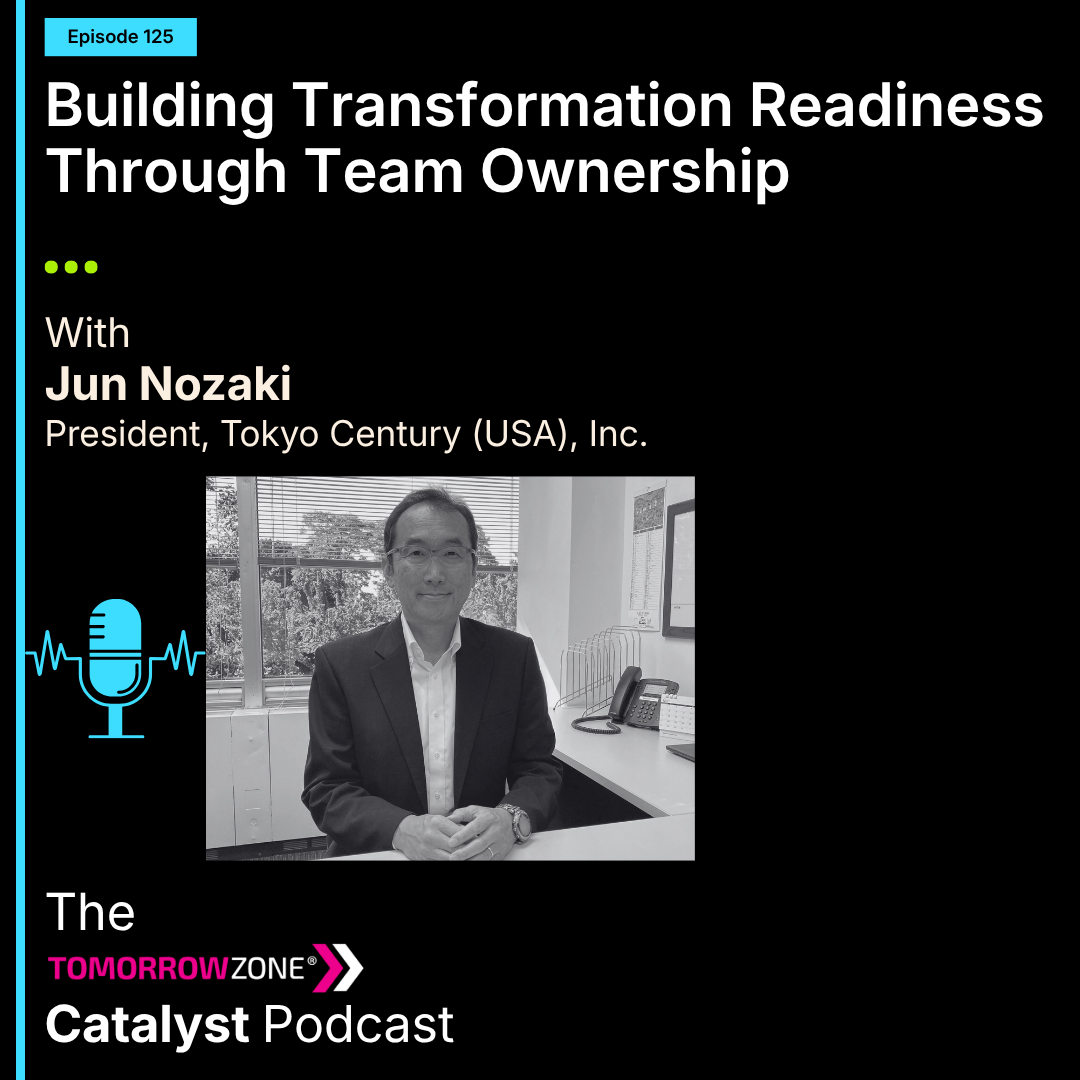
125: Building Transformation Readiness Through Team Ownership with Jun Nozaki
About this Episode
Two technology initiatives followed similar development approaches. One succeeded. The other fell apart.
What made the difference?
In this Future Shaping Leaders episode of The TomorrowZone Catalyst Podcast, Deborah Reuben, CLFP, Founder and CEO of TomorrowZone®, talks with Jun Nozaki, President of Tokyo Century (USA), Inc., about what his team learned while advancing a significant digital transformation and building greater transformation readiness along the way.
Jun’s experience offers a useful perspective for leaders facing a familiar challenge: technology can move forward while cross-functional misalignment keeps the organization from moving with it.
Seeing the Business as One System
Tokyo Century USA has been shifting toward a more data-centric operating model, including replacing its ERP and developing Customer 360, a unified view of customer data and interactions. The goal goes beyond efficiency. Jun sees data and technology as tools for creating greater value for customers in a changing equipment finance market.
Early in that journey, Jun and his team engaged TomorrowZone® to look across the business before moving further into the technology.
By mapping workflows across functions and connecting perspectives that had previously been viewed separately, the team gained what Jun describes as a bird’s-eye view. They could see pain points more clearly and, more importantly, develop shared understanding around the issues that needed to be solved.
That shared understanding created ownership. Jun later saw that ownership become an important force behind the team’s Customer 360 work.
It is a real-world example of leadership alignment before technology, and of why strategic clarity matters in cross-functional transformation.
When Ownership Changes Leadership
The experience also challenged one of Jun’s long-held beliefs about leadership.
He had always believed a leader should lead from the front, especially when the work became difficult. As the team began working differently, he saw people taking greater responsibility, contributing ideas, starting conversations, and proposing new possibilities themselves.
His own role began to change.
Instead of supplying all the momentum from the front, Jun increasingly focused on creating the conditions that allowed the team to move together. As people gained access to more data and a broader understanding of the business, he noticed a question surfacing more often:
“What if?”
Those questions led to experimentation, co-creation, and new momentum.
Building Readiness for What You Cannot Predict
AI adds another layer to Jun’s story.
Looking back, he admits that the speed at which AI and AI agents moved into practical use would have changed some of the team’s earlier technology decisions. Yet the experience also developed something more durable: a team increasingly capable of learning, adapting, and creating value as the possibilities change.
After reading Deborah Reuben’s Enter the TomorrowZone: How to Inspire Breakthrough Innovation and Shape Your Future, Jun recognized many of the principles in what his team had already experienced. He is now applying the TomorrowZone System™ as the organization moves forward with Customer 360.
That connection gets to the heart of transformation readiness. Leaders cannot predict every technology shift ahead. They can build the shared understanding, ownership, and capacity to respond when conditions change.
In the full conversation, Jun and Deborah explore what separated two very different technology outcomes, how the experience changed Jun’s approach to leadership, why business experience still matters in a data- and AI-driven environment, and what his team is learning as they continue to shape what comes next.
Connect with Us:
Ready when you are.
If you own the outcome and you are at an inflection point, this is where a direct conversation about your situation starts.
Fifteen minutes to see whether this is a fit, and what that fit looks like for you.
Not ready for a conversation? Start with the book.
